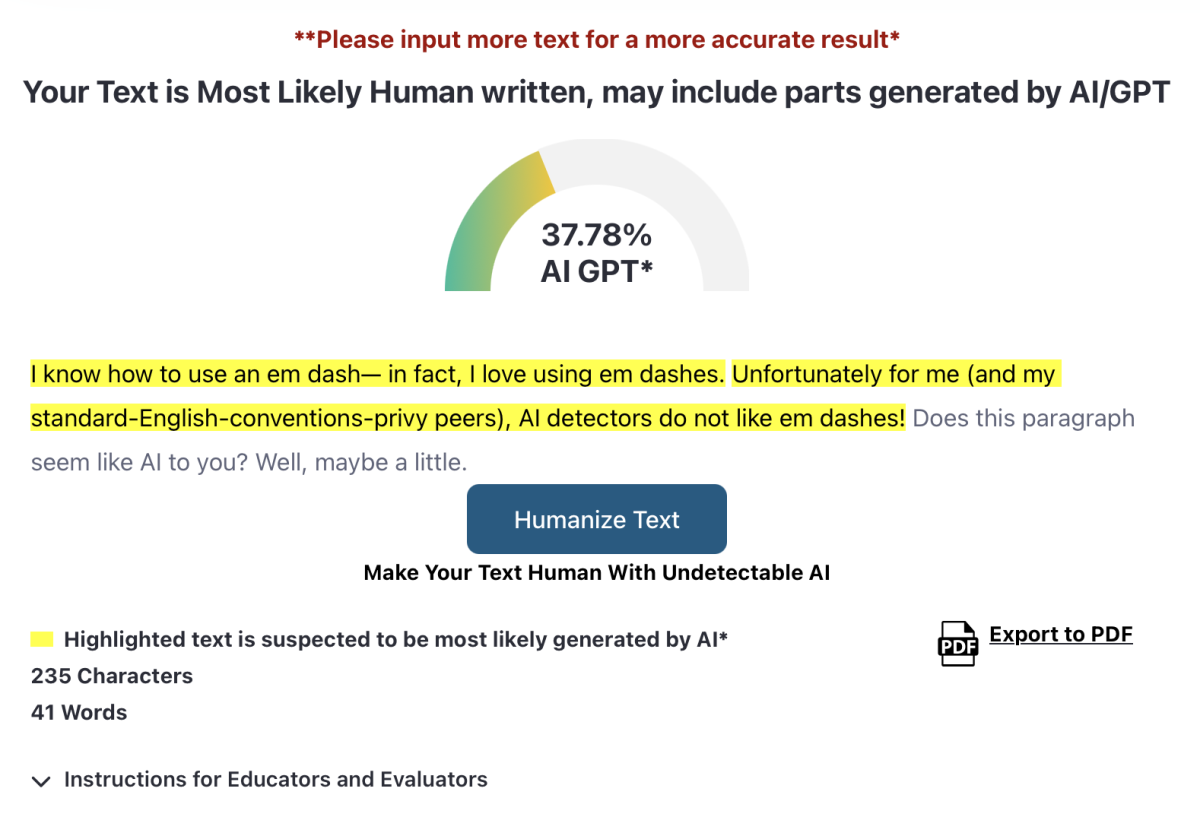
I know how to use an em dash— in fact, I love using em dashes. Unfortunately for me (and my English-privy peers), AI detectors do not like em dashes! Does this paragraph seem like AI to you? Well, maybe a little.
Okay, I’ll spoil it for you. That paragraph wasn’t written by AI. Neither are most of these paragraphs to come (view the end if you want to see what AI has to say about real essays). If you said that the first paragraph was AI, so did an AI detector. To be more exact, it was said to be 38 percent AI-written.
So, what does this mean for students and teachers? As AI becomes increasingly ubiquitous, we’re running into a growing dilemma. Artificial intelligence feeds off of what it is taught by humans, whether directly or indirectly. Whenever someone places a sample of writing into an AI detector (which uses AI software), it is learning more and more about language conventions, emotion in writing, and figurative language. At some point, artificial intelligence will have learned so much about common English writing that it will (or already has, if you ask me) simply represent human writing.
Think of it like being in English class. In pre-k, you learn phonics and spelling. In second grade, you learn the difference between the ‘theres’ and the ‘yours’ with a sprinkle of the parts of speech. You keep building onto this as you inch toward middle school, and your teachers are starting to ease you into the norm of writing essays and paragraphs. Then, you get to middle school and must learn theme, sophistication, and tone. In high school, you’ll refresh and build upon all of these skills, and they’ll start to come together until you are a solid, distinctive writer.
AI does the same.
We’ll just skip ahead now and (roughly) equate AI and the strong high schooler or college writer. Some teachers have thresholds for the percentage of AI detected that they chalk up to simple error. Others have a zero-tolerance policy. When it comes to AI detectors, cogent writers who adore intentional, structured patterns and adding variety to their punctuation are inherently facing the brunt of AI’s punishment. AI sets off an alarm for writing it analyzes as being too sophisticated; thus, eloquent authors may have to face the constant accusation of using AI, or they may lessen the quality of their work to avoid such conflicts.
I’m not calling for the abolition of AI detection platforms. I still hate artificial intelligence in education (and for most things, honestly), but it’s worthwhile to invest in other systems to sniff out AI in writing. Instead of copying and pasting work or running it through an analysis software, timing and previous writing samples should be used as a baseline for comparison.