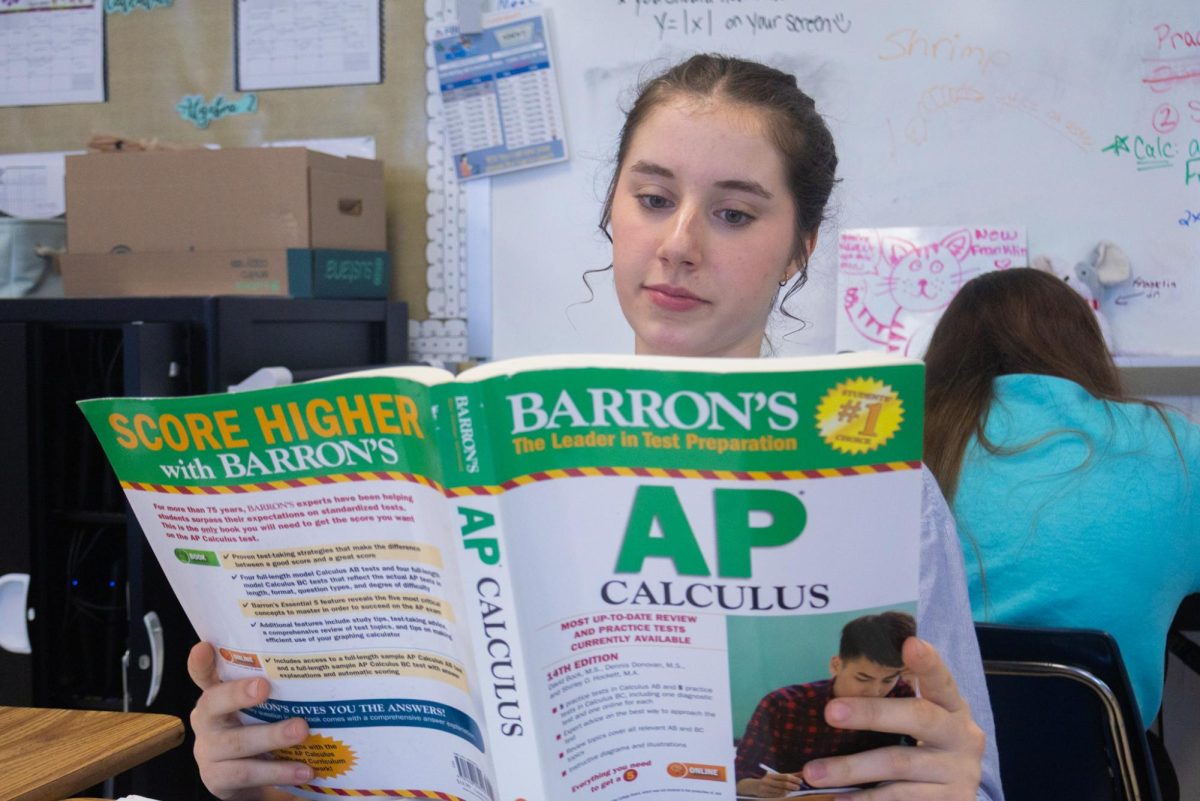
Sivani Kandel walks into the library with her classmates. It’s cold and quiet, the air hangs thick with anxiety. She’s studied all year for this test. It’s time for her work to come to fruition. The students chat while they nervously wait for their examiner to direct them to their seats. Slowly, they begin to log in, setting their panic aside. This is how many students feel as they make their way into their AP exams, and others as they prepare for their finals. AP classes provide students with the opportunity to take college-level subjects for college credit. However, to earn high scores, students must study.
Studying for AP exams is one of the hardest parts of taking them. Its over knowledge acquired over a whole school year. Beyond this, many students find the last few days the most stressful, including junior Lydia Walker.
“The part of AP exams I find the most stressful is actually the night before, because knowing that the next day, you’re going to wake up and sit down and take a really long test, and that knowing that you care about the outcome, that’s the most stressful thing,” Walker said. “But something that [band director] Mr. Steck has always told me is, if you stress about something, you know that you just care about it. So being able to take a step back the night before, that’s really important.”
Meaning that one needs to prepare. Starting with feeling normal, getting good sleep, and being awake and ready for tests. But studying is just as — if not more — important. Junior Sivani Kandel has found a method that works well for her.
“I’ll usually sit around and do homework for about 30 minutes to an hour, depending on what I have to do that day. During this time, [I’ve been] consistently spending an hour just doing review,” Kandel said. “I sit down at my desk or on my bed, and I pick up all my work, I put it in a pile, and then start. I take good notes across the entire year, so if I see anything there that I don’t immediately remember, I write that down and go back and watch a video over that, [or utilize] practice problems.”
There are a variety of methods used to study; it all depends on the class. Senior Luke Stallings utilizes a few simple methods.
“What helps me the most is taking a break from studying and finding other things to fill the time. Other than that, just watching videos on the topics that I’m studying [helps],” Stallings said.
Meanwhile, it’s still important to study as much as possible for the class. In order to focus on classes in which she struggles, Walker employs a simple order to prepare.
“I break down each class into the different units, or the different things that I need to study the most. Taking a practice test is really beneficial in narrowing down your focus on what you need to improve on the most,” Walker said. “Then, I spend the two weeks leading up to the exam [studying], I spend the first one on about half the material, and then the second week is on the material that I know better, but I still need to re-familiarize myself with. So then by the time the week of the exam comes, I’m able to just focus on the generalities and recap everything to make sure it’s fresh in my mind.”
There are many apps and websites to help study for AP exams, but what helps most is to focus on relearning the beginning of the year and to quiz yourself. Further, in order to relearn the content, Heimler’s History and Crash Course are great YouTube channels for history and science classes. In English Language classes, Garden of English is another option. Laurie Fay, the AP language and composition teacher, recommends repetition for success on exams.
“Like anything in life, practice, practice, practice. Because the more you do something, the better you understand it,” Fay said.