It’s Thursday evening, you’ve spent all week making up missing work and it’s finally time for you to work on Spanish. You find yourself exhausted but you have a quiz on the preterite tomorrow. The issue however is that no matter how hard you try, you just can’t seem to memorize the verb endings.
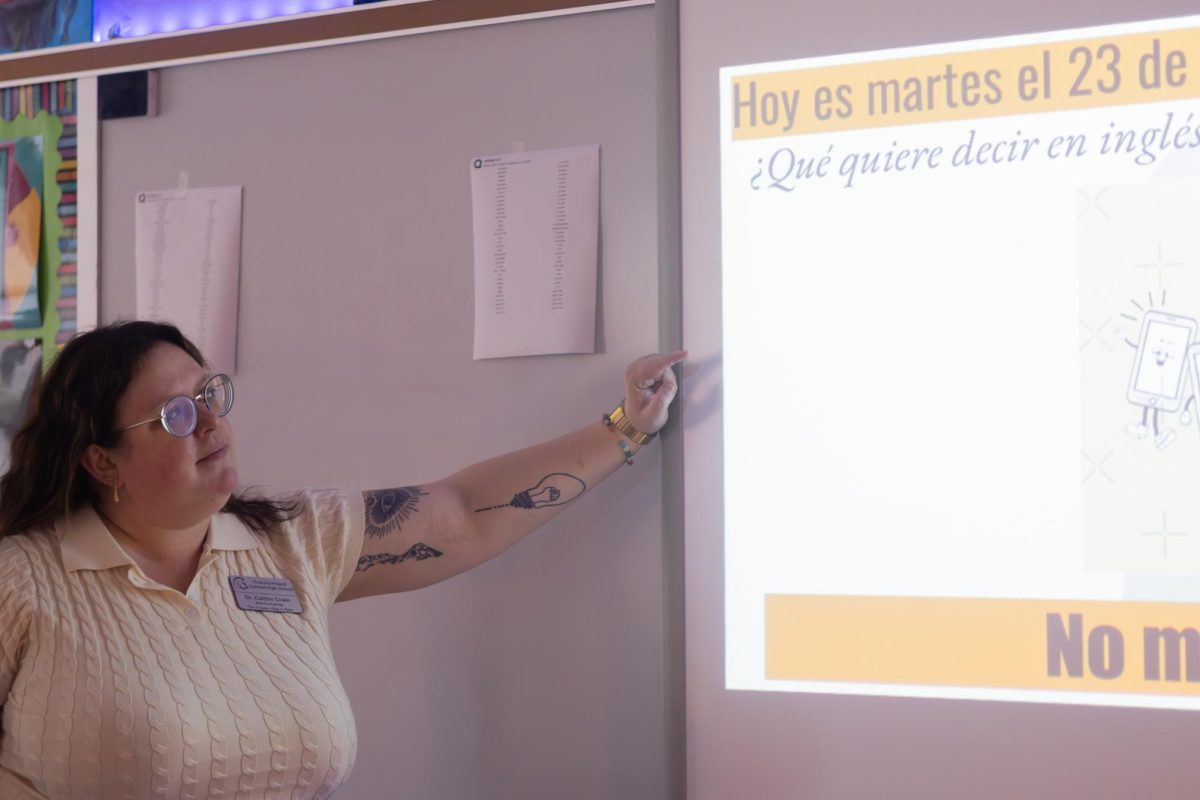
This was the issue that sowed the idea of a grade-less system for the language classes. Many of the language teachers traveled to a conference in March. Senora Crain, a Spanish teacher, says that it was based on a concept called Ungrading.
“I went to a session on this concept. It’s called ungrading, and it basically was all about taking the emphasis off of points and putting the emphasis back on learning, so I wanted to try that out, because I felt like sometimes grades are not an accurate representation of what somebody knows.”
Some students may be poor test takers, others may struggle with turning assignments in online, many may follow the rubric for the grade and not the learning associated with the class. All of these were things that the language teachers wanted to address. According to French teacher Amy Roznos, the language teachers spent a lot of time deciding how things should function.
“Four of the four teachers that are doing it here, met for an hour and just kind of figured everything out, you know, like things like, you have to have a grade every quarter So what is that going to look like if students want to flex, because some classes are blended classes, they have to have an eighty percent so how are we going to do that?” Crain said, “we want it to be really reflective. And every assignment that I’ve ever assigned in the past had points attached to it. So it’s rethinking everything of how are we going to make it so the points don’t matter as much to students? So yeah, it was a lot of work, and we’re still figuring it out.”
The way the system works is that students get feedback from their teachers on the assignments they turn in. Assignments are on a four point scale and class grades are built on the effort evident in your work and studying. Crain said that it works in two distinct phases.
“So the system basically is that there are two parts. There’s a portfolio and a learning commitment. The learning commitment shows you what effort that you need to do, to put forth in the class, to show that you’re like, you know, learning the content. And then a portfolio is like, a sample of like, what you’ve done over the course of the semester. Basically that. What that means is that you start in a place, and wherever that place is to say you’re in Spanish two,” Crain said, “you show you how you grow over the course of the semester and that, and how much effort you put into the course. And if both of those things are in place, I mean, you’ll get the grade that you want. And it happens to be a conference with the teacher at the end of the second quarter, about what the quarter grade looks like for you.”
Although, trying a new system for how students grades worked was certainly not without issue. One of the biggest worries that would come with the new grading system is how parents and students would respond. Roznos said she was concerned about how students would feel about the four-point grading system.
“I wish that, like in Canvas and Infinite Campus, you could just say you’ve mastered the skill, but it’s all based on a point system. So I have to put a three. And a lot of students, if they see a three out of four, they think that’s a seventy five percent but for me, I’m like, oh, that means you’ve mastered the skill. You’re one hundred percent good to go,” Roznos said.
So far, many students like the new gradeless system. Although the initial reaction was certainly mixed. Many students don’t know necessarily what a new gradeless system may entail. Many students may avoid doing hard work if they don’t have to. Aspen Releford, a Spanish 3 student said she worries the new gradeless system may allow Spanish to be a lower priority within her course load and lessen her will to study and learn.
“I mean, I’m not struggling, but I’m also not really learning,” Aspen says, “because kids just try to do less work, so they just take the easy route.”
The primary strength of the system would likely be the flexibility the gradeless system brings to students, but it comes at the cost that students must want to learn and apply themselves. It focuses more on teachers giving feedback than grades. That means students have to spend more time looking at what their teachers have to say to them. Roznos said that this is certainly one of the highlights of the system since it allows more and better feedback.
“I mean, we’re only a few weeks into school, but I’ve been giving a lot more feedback than I normally would in class, because I just said, well, the grade is the feedback, but now you don’t have grades, so I’ve been giving more feedback, and I’ve been asking students to reflect a lot more,” Roznos said.