The first time many readers encountered Percy Jackson, he was a silent presence.
He lived in the paperback’s fractured spines and dog-eared corners, hidden away in backpacks and read in passing moments. Percy’s world opened to him in private, forged less by the spectacle than by the imagination. Camp Half-Blood was a different thing altogether to each reader; its topography personal. Percy’s voice came out different in every mind. The story worked because of its tacit agreement: structure was what the text supplied; texture, the reader.
That version of Percy Jackson belonged to one medium, and that medium dictated how the story was consumed.
As the series migrated beyond print, Percy Jackson fell into a cycle–or grave–familiar to modern storytelling: adaptation. Each new iteration reconstructed the audience’s relationship to the narrative–consumption patterns changed with format, changing the ways in which the story was encountered, discussed, and remembered.
In its original literary form, Percy Jackson and the Olympians was an intimate experience. First-person narration created immediacy, collapsing the distance between the reader and protagonist. Percy spoke directly to his audience, frequently with irreverance, placing the reader not as observer but confidant. Pacing was more elastic, determined by the reader’s engagement rather than external time constraints. Meaning gathered weight over time, reinforced through rereading and rumination rather than spectacle.
Reading Percy Jackson was a matter of sustained attention. It was a linear, immersive, and largely solitary act. Without visuals, ambiguity could persist, and this meant that characters and settings were allowed to exist in a state of imaginative plurality. The depth of the story relied on the interpretive participation of the reader.
Inevitably, the first film adaptations marked a turning point. Condensation is essential to cinema. Either by necessity or design, narrative intricacy is forced into a straitjacket to suit the running time, and interiority becomes externalized through action, dialogue, and visual shorthand.
On screen, Percy Jackson’s story was a dichotomy; more immediate and less expansive. Character development was hastened. The plot was compressed. A mythology that had been layered and gradual in its unfolding was now more declarative–which, aside from the fact that the films were an absolute abomination, tantalizing to watch, and a disgrace to Rick Riordan himself, was a cautionary tale of what occurs when adaptation prioritizes marketability over narrative integrity, reducing a text built on voice and perspective into a hollowed-out spectacle.
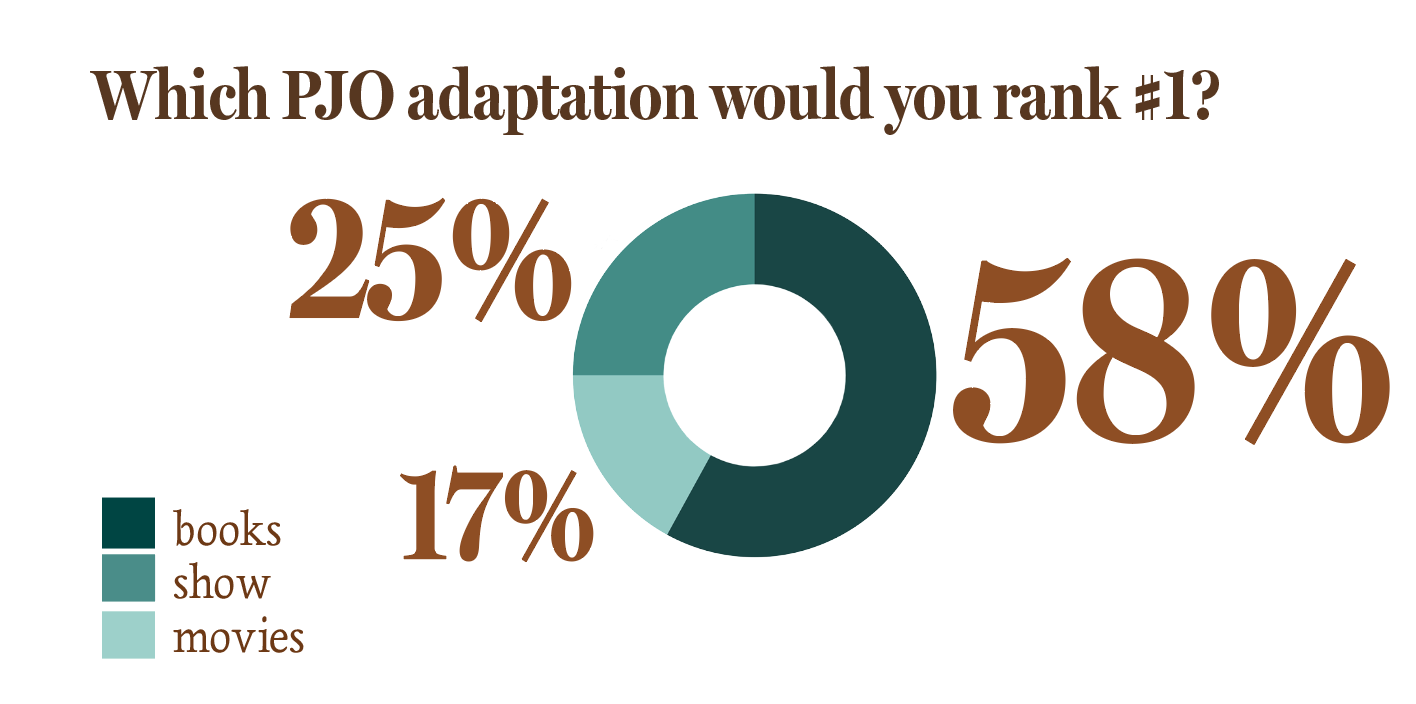
The films rendered Percy Jackson visible in a way the books never required. Although the films introduced the franchise to a broader audience, they also altered the mode of engagement. Watching a film is temporarily finite and largely passive. The audience receives a story at a predetermined pace, with limited opportunity for pause and reconsideration, transforming consumption.
Years later, of course, a serialized streaming adaptation created another pivot. Long-form television represents a middle ground between literature and film, marrying visual immediacy with the sprawl of a narrative. Episodes permit extended development, while seasonal structures spur more sustained involvement. Percy Jackson, in this iteration, was episodic, not linear.
The streaming adaptation redesigned narrative emphasis. Scenes that occupied paragraphs in the books expanded into full sequences. Character motivations were articulated with greater explicitness. Emotional arcs began to be rendered with deliberation, often foregrounded through dialogue and pacing. The mythology, while still rather overlooked and somewhat inaccurate, was more contextualized.
This format reorders audience behavior. The episodes being dropped on schedules — every Wednesday, in this case — encouraged anticipation, speculation, and retrospective analysis. The viewers not only watched, but rewound, revisited, and discussed it all on digital platforms. A shared cultural text, communally experienced but asynchronously.
This level of scrutiny did not leave the narrative itself intact. Episodes prompt urgent responses, and those urgent responses inform how stories are understood. The story gets told with a running bass line of analysis and recap, a multi-textured experience in which the story itself and its reception coexist.
This multiplicity altered memory. For early readers, visual adaptations retroactively influenced how the books were recalled. For newer audiences, the books functioned as supplementary texts, offering an expanded context rather than a primary experience. The hierarchy between source material and adaptation became increasingly fluid.
These reflect different format demands, not a departure from an original narrative. Literature privileges introspection. Film privileges immediacy. Television privileges continuity. Each medium shapes not only how the story is told, but how it is received.
Yet, amidst these transformations, there existed some constants with regard to the narrative. The story remained centered on displacement, identity, and belonging. Percy remained the protagonist who was constantly set against a world that continued to define him while resisting the same. That throughline stayed constant regardless of format, providing some cohesion across adaptations.
In this way, Percy Jackson exemplifies the modern narrative lifecycle. The story adapts not only to new mediums but to new modes of attention. It accommodates shifts in how audiences consume media more visually. Percy Jackson no longer exists strictly as either a book series or a screen adaptation. It is a constellation of texts, each contributing to a broader cultural presence. The plot stays recognizable, but its delivery evolves. A contemporary myth to some extent, forever changing in minute details, yet somehow remaining perceptually relevant. The endurance of the story lies not in any fidelity to being unchanged, but in its capacity to be retold.
A modern Ship of Theseus — rebuilt plank by plank, its hull replaced, mast renewed, sails exchanged until no original piece remains, yet still bearing the original name and function — Percy Jackson persists through alteration without forfeiting identity. The question that haunts the myth lingers here as well: when enough is changed, does the object remain the same, or does continuity reside not in material components but collective recognition and memory?