Writing is an important part of the student experience; students regularly write essays, short stories, and just bland sentences. But rarely do students really consider the artfulness involved in writing, especially in their free time, where students can express themselves freely and create for the sake of themselves. There are many ways this can be done, like in non-fiction (in that people can write about subjects which interest them), poetry, and in fiction stories. Fiction gives many different ways to express oneself, while also being easily accessible and sharable with others. Melissa Fry, one of the creative writing teachers, said this is one of the most important parts of writing.
“Storytelling and writing can help us understand ourselves and the world better,” Fry said. “Sometimes I don’t truly know how I feel about something until I start writing about it.”
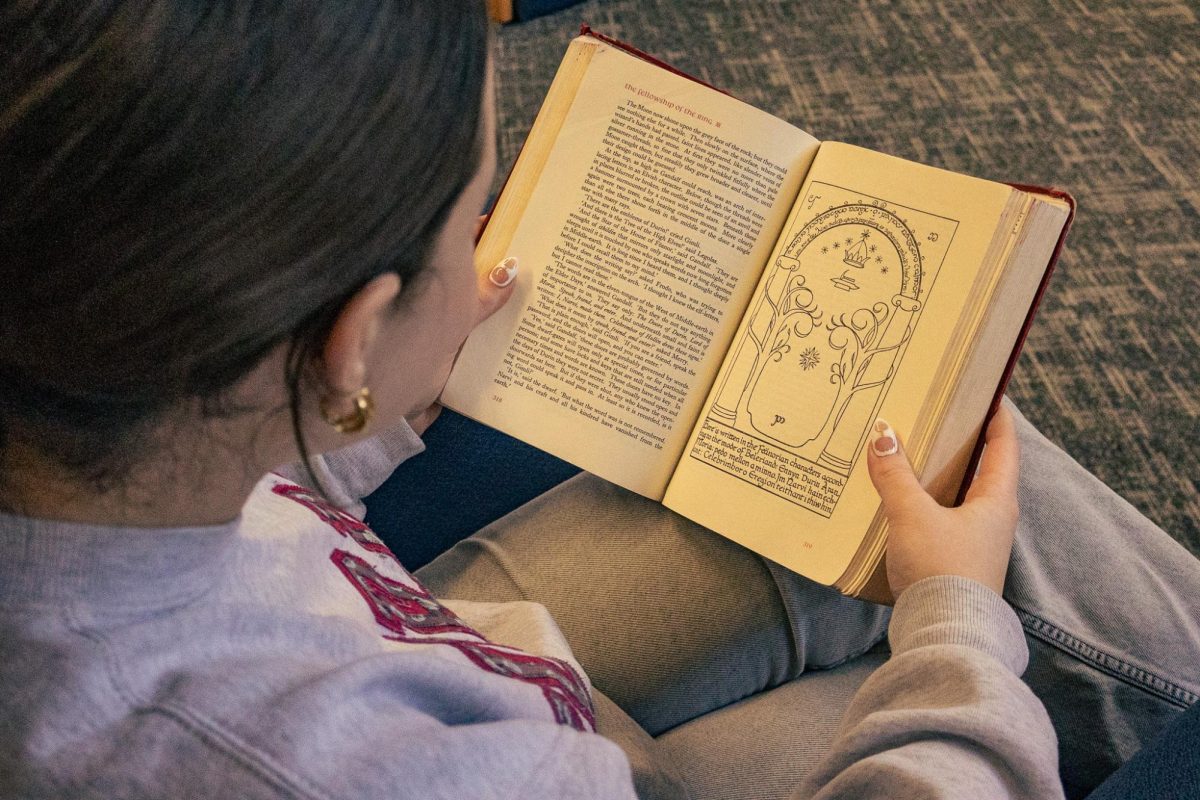
Fiction, as all other forms of writing, is an art. But there’s not necessarily a requirement for any foreknowledge, especially as a person trends towards fantasy. It also can be used to express many complex ideas, like existentialism, or can be written for the sake of a good story. Fantasy provides extra opportunities to be imaginative, from the wide histories of Tolkien’s Middle-earth to the multiverse that is Brandon Sanderson’s “Cosmere,” things can be as true to life or as far from it as the writer wishes.
In fantasy, one of the easiest ways to get started begins with finding inspiration. Whether it may be a concept of a world, a hopeful ideal, an imagined villain, or a hero overcoming a difficult obstacle, there are many places to start. Junior Max Sarver, who likes to be a dungeon master (the player who creates the world and narrates the story for the other players) for his weekly “Dungeons and Dragons” (D&D) game creates stories like this regularly.
“I think of this world that I want to create in my head, and then I just kind of come up with scenarios for my friends to go through,” Sarver said. “[I like to add] certain values, appreciating smaller things in life, bigger things in life, family and looking for friendship and fellowship.”
Meanwhile, it’s important to have strong protagonists, but they need to have flaws or missteps in order to be relatable to the audience. A good way to do this is to give the protagonist a flaw that is an aspect of the villain, or a reason that the villain is the protagonist’s enemy. Sydney Limpert, a member of Sarver’s “Dungeons and Dragons” game said that among the ways she designs flaws, is by the lessons a character could learn.
“I get a vision for a character, what I want them to look like, act like. Then I look at what they look and act like, and then I think what would suit them for a lesson for them to learn,” Limpert said. “For example, one of my characters is an artist, a musician, and she’s struggling with knowing that she is good enough because she puts her identity into her work.”
But there’s more to a character than their flaws. Characters also need to seem to the reader to feel alive. One way this can be accomplished is by giving them unique and strong personalities that stick with the reader long after the story ends. Limpert said there are many different unique character personalities she uses for her characters.
“[I like] giving them very different personalities, because I have three main D&D characters that I play. One of them is like a bubbly little bookmark, and another one is a very anxious high schooler that does art and theater and stuff like that. And then another one is reserved. She doesn’t like talking to people. She’s not trusting of people. She likes to be by herself,” Limpert said. “You just need to make sure that your characters aren’t the same blank slate. ‘I like to fight. I’m the hero.’”
However, to have a hero, they have to face adversity. Villains can be one of the most interesting players in your story, beyond the characters of course. In fantasy, they often create worldending stakes, but they can have smaller stakes depending on the story being told, like environmental destruction for the sake of greed, or for control of a single town. Sarver often creates villains that complement other aspects of the story.
“I go back to [the theme], because most of the time, whenever I make a theme, I have a villain in mind, or I look at their character’s backstories,” Sarver said. “I’ll have the villain be introduced, be there, not much of a nuisance, more of a nuisance, and then slowly [become] more and more threatening to them, specifically trying to kill them.”
Meanwhile, Limpert likes making villains more relatable.
“Typically, humanizing them is what makes it hit deeper in your heart when it is more human, like, whenever the villain doesn’t have a choice or is too far gone for love or fame or something, but occasionally I do like having a straight-up evil villain that is evil, because why not?” Limpert said. “I look at what the objectives and goals of the characters are, and I find ways to have the villain insert themselves. So like, if they’re trying to rescue someone, they’re trying to find missing people, then the villain is responsible for these disappearances for XYZ reason. They were trying to do XYZ.”
In all, there are many tips for fledgling writers. But some go beyond the page.
Sarver said, “Don’t stress yourself out, take breaks in between. Make sure it’s not what other people want; make sure it’s what you want.”
Meanwhile, “Do not be afraid of making mistakes, and procrastination is completely okay whenever you first start, because I am still a procrastinator, and what you really need is just an outlet to get all your ideas out, and then you go back and edit,” Limpert said.
Remember, it’s all about passion, not perfection.