

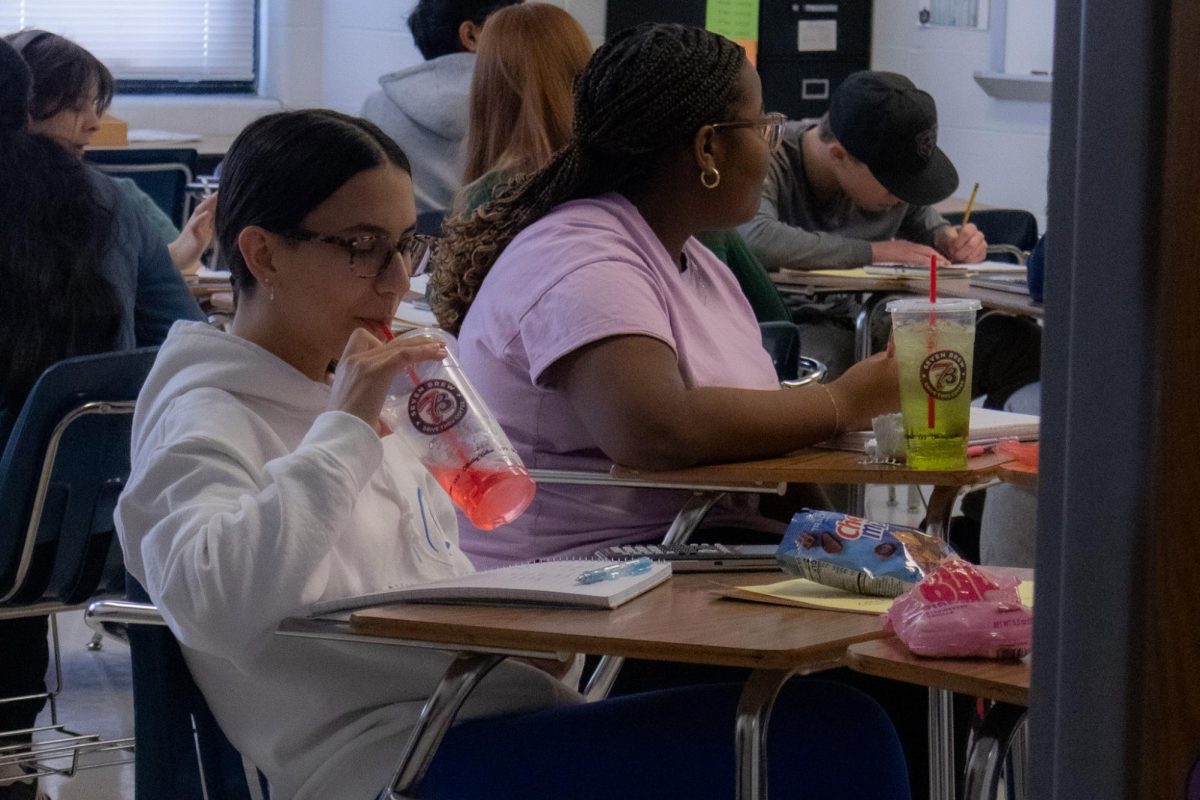
One of the most prevalent objects among students, beyond the pencils and books, the papers and folders, is the daily caffeinated drink. Students often find them useful and tasty ways to get their day going, and to keep it going. But others recognize that there are many potential risks associated with energy drinks. This leaves many students questioning energy drinks and coffee as a whole.
Currently, there are many students who drink energy drinks daily; their addition to the school cafeteria hasn’t helped. Many students pick up a Kickstart at lunch or bring a Monster in the morning, and some even leave for 7 Energies from 7Brew during flex hours. But why? Many students choose to utilize caffeine for a purpose, like AJ Webber.
“I usually utilize it for a purpose, because a lot of the time I have really long days, I wake up at 5 in the morning almost every single day, and then I have to drive an hour to school a lot,” Webber said. “Then I have late days when I’m at work till 10:30, and so I just need the caffeine to get me through the day.”
But there are potential risks associated with consuming caffeine in large quantities, Elizabeth Nix recognizes.
“I know once I drink at least two, I get really shaky, and then I know there are a lot of risks that can get you in the hospital,” Nix said.
But there are more side effects than just feeling shaky; They can cause heart issues like arrhythmias and elevated blood pressure. The caffeine will also act as a diuretic, meaning that it will cause a person to use the restroom more often and thus become dehydrated more easily. However, Andrew Carter said that there are other long-term effects.
“[If] you can’t function during your day without it. That’s an addiction,” Carter said. “So the reason why I don’t use caffeine is because I would go through bad withdrawal headaches, and this was even just from drinking a soda. If I had a 12-ounce Coke, the next day, I would get a bad headache due to my caffeine withdrawal. So for me, not even using [caffeine] is [the] ideal situation. I can only imagine what it is like for someone that’s drinking energy drinks.”
Yet there are many different causes that drive students to start drinking energy drinks. Some may because they like the taste, or because of late nights and stress. However, Andrew Carter has other reasons he believes students like to drink energy drinks.
“Energy drinks, just like going to Starbucks or going to Seven Brew, is kind of like a status thing. showing off. What do you have today? Oh, I’m drinking an Alani, or I’m drinking this. I’m drinking that,” Carter said. “So I think it’s just another accessory that’s added to what people have to show off. I think that’s the draw with it. The draw that people get from it ends up being those feelings that they get from using it, the attention that they get [from] trying to add color and stuff to it as well. It’s the same thing that they did with vapes by making flavors and adding colors to [them]. It’s all marketing.”
Many students recognize that energy drinks can have potentially harmful effects, especially if consumed in large quantities. Yet they persist in drinking them. Many are also trying to reduce the amount of energy drinks they consume, but may find it difficult to find alternatives. Webber says there are a couple of things she thinks could help her reduce her intake.
“I think a lot of times being able to get up in the morning is a hard task, just because I’m so tired from the night before. So I think having help, especially from my family, helping me and making my breakfast, because a lot of times I don’t have time to eat, and so I just skip breakfast entirely,” Webber said. “But I also think just a small reminder like, ‘Hey, you’re doing great. It’s gonna be a great day, don’t worry about it, even though it’s gonna be a long one’ would help.”
In all, caffeine addiction often arises out of a dependence on caffeine to get things done or through peer pressure. It can be harmful to drink energy drinks and coffee in large quantities, and it is important for people to limit and track their caffeine intake. If someone finds themselves struggling to perform without doses of caffeine, it is important that they reduce their intake to prevent further dependency. Students should ask for help if they need help to reduce their caffeine intake.


Amanda • Apr 2, 2026 at 10:06 pm
I agree completely! Caffeine has a lot of medical side effects like you mentioned. I’m an adult and took myself to the hospital after an energy drink that caused my resting heart rate to be in the 130-140 (normal is 60-80). I don’t want to imagine the effect caffeine is having on still developing hearts, minds and bodies. Please take care of your heart and body. You only get 1.