
My yawn interrupts Dua Lipa’s singing, which erupts throughout the air. The kitchen is our temporary dance floor, and Maja bumps her hip against my side to playfully knock me over. We both got sick from the two trays of Pillsbury Valentine’s Day Cookies we (accidentally) ate. We’re deliriously tired, but there’s so much energy between us that we can both tell it’s still not time for bed. I rifle through my designated sleepover bag, trying to find crochet hooks and yarn. Maja waits for me at the table, and I scamper over with our next adventure. Two hours later, there are approximately zero rows of stitches. We were too busy laughing, gossiping about the latest middle school mishaps and Maja’s work drama; it was near midnight, and realistically, teaching her to crochet was not going to happen.
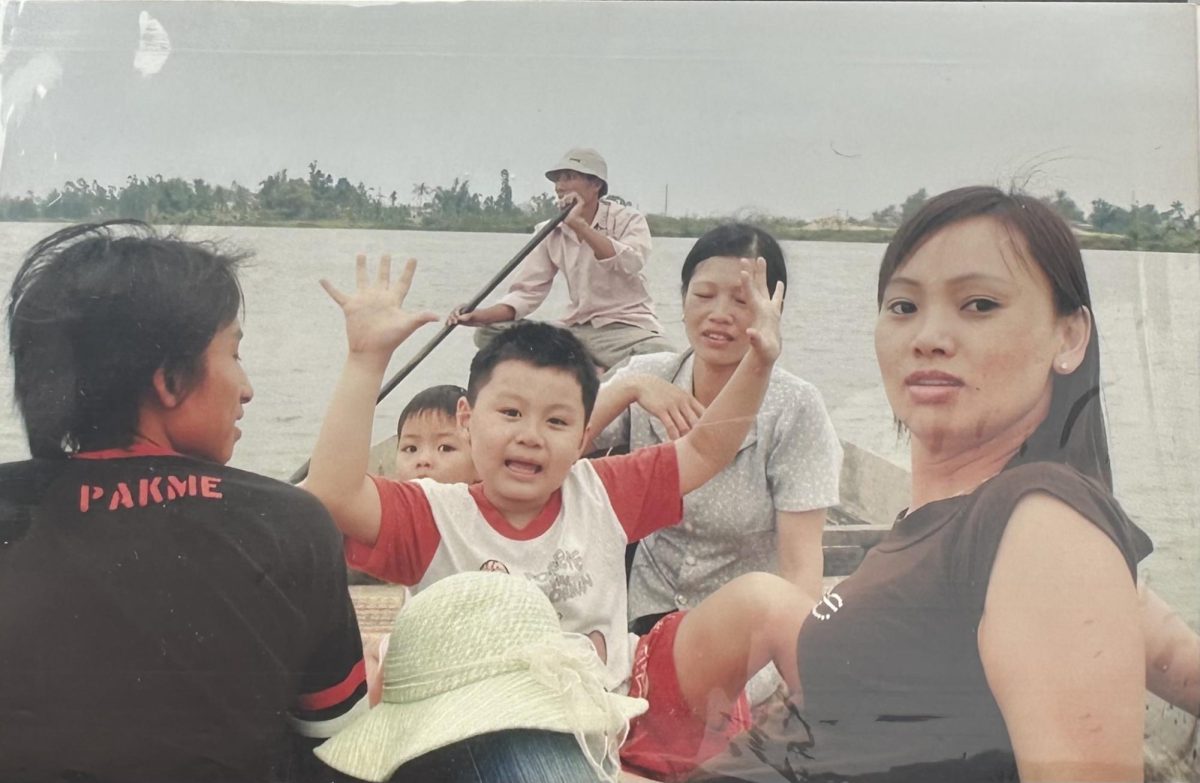
Meet Maja, whom she and I introduce as “my Serbian aunt.” Maja has lived in the U.S. for nearly as long as I have been alive, yet her accent and occasional chatter in Serbian raise suspicion about her legal right to be here.
Her story isn’t unique.
Senior Katie Huynh, my closest friend, would not be here if her parents had not immigrated to pursue “the American dream” nearly 30 years ago. Immigrants are often stereotyped as lazy, violent criminals. Most of the time, this is further from the truth.
“My parents have always instilled [a] hard work mentality within me. Obviously, everybody has a hardworking side to them, but it’s different when your parents are immigrants. I’ve always had this weight of knowing that my parents had to essentially start from literally nothing to get to where they are now. Having to immigrate…from home to a place where you don’t know the language, don’t know the culture– essentially don’t know anything about the place to try and grow a family, grow a life. I’ve always had that weight on me when I do things, and I want to make them proud, but also [I want] to carry on that mentality of ‘hard work gets you to a lot of places’,” said Huynh.
Huynh associates this mentality partly with the privilege gap between her and her parents.
“You also have to be aware of your privileges. Having immigrant parents, they didn’t have a lot of those privileges in the first place, so I appreciate my parents and immigrants for that.”
Immigration is inherently perceived and rooted in the value of a checklist: are they “illegal”? What economic value do they bring? Where did they immigrate from? The backbone of our country was formed on the idea of ethnic heterogeneity, whether through the Yorubians involuntarily taken through the Middle Passage into America or by the Ashkenazi Jews, who immigrated to the U.S. to escape religious persecution during World War II. In any manner, sacrifice was derived from their migration. Freshman Veronika Naichuk, who immigrated from Ukraine because of the Russo-Ukrainian war, frequently misses out on the central pieces of her cultural and family identity.
“[Ukrainian church is] an hour away from here, but [my family and I] go there. We don’t believe in that religion; we’re Catholic, and it’s Greek Orthodox, but it’s Ukrainian,” said Naichuk. “I don’t have a family here. So, the holidays here, I don’t get to experience them as I feel most Americans do.”
In three and a half years, Naichuk has attended three separate schools. Her family’s life was well established in Ukraine, but the immigration process required her to start again from the very beginning— a phenomenon best embodied by her parents.
“…. My parents are always at work, because in Ukraine, they had a house, we had everything, and then we moved here, and now they’re always at work to get us to the life that we had. So, especially our first two years here, they were constantly at work and barely home,” Naichuk said.
While her adjustment hasn’t always been smooth sailing, Naichuk has thrown herself headfirst into participating in the local community. At the beginning, learning English and American customs seemed like an impossible task to her. Now, she has observed the tremendous growth she has made over the past three and a half years. Naichuk is a cheerleader for FHC, a STUCO member, and an all-honors student, which she attributes to the reason her creativity has blossomed.
“I’m way more creative here than I would have been in Ukraine. Making new friends and people that I know and I can talk to, and meeting new people from different cultures and learning about that, it’s very exciting,” said Naichuk.
Despite her engagement with others and positive outlook, Naichuk has faced extreme bullying from her peers.
“ …When I just moved there, and I didn’t know any English, people would make fun of me and of my accent. There [were] mean people who thought that it was okay to make fun of me just because I wasn’t American, and it was some really bad cases. A girl decided to spill a water bottle on me on the bus. At school, I would be walking [the] hallways, and she would look at me, and she’s like, ‘You stupid, nasty bitch.’ I did nothing wrong. I don’t even know her name,” said Naichuk. “Some people think that it’s funny to joke about ICE, and they’re like, ‘You’re going to get deported, ‘ or [students] joke about [my brother’s] accent, which I don’t find funny…He says that it’s fine, it’s just funny jokes. It’s not just funny jokes. Because if you let people do that, they’re going to keep doing that to other people… and then they grow up to be like that.”
Combined with the stresses of the immigration process, the bullying Naichuk faced during her assimilation left long-lasting consequences on her health.
“It’s definitely an insanely hard and challenging process. I’m a very positive person, and I have a very positive outlook on life. I feel by me, you can’t tell how hard it actually is, but immigrating here and starting in a new school and everything new [gave] me so much anxiety and stress disorders, that last year, my body gave out from all of the stress consumed, and I was at the doctor’s all the time. I still see my neurologist regularly because of how bad all the stress and everything affected not just my feelings, but my mental and physical health.”
We’ve all heard the phrase “never judge a book by its cover.” If you ever get the pleasure of meeting Naichuk, one of the first things you’ll notice is her effervescent personality. Most likely, she’ll invite you to a conversation to get to know you, and if she’s not, she’s probably floating around the classroom, looking for ways to help others. I say all this to show you that our perception of others does not reflect their full story.
In the same way, no immigrant’s story is the same. Some families fled to the U.S. out of fear they would not survive in their home country; others pursued the opportunities inscribed in America’s conceptualization: the pursuit of life, liberty, and happiness. Our Constitution ensures the equal protection of all, regardless of their origin, yet we’ve found ourselves in the crossfire of a time when the word “hate” has taken its place, and our founding values seem to be a whisper hidden by a loud wind of voices screaming against one another. For Naichuk, this struggle manifested itself in the form of physical and mental distress; for Huynh’s mother, these hurtful words were unheard; rather, she understood the feeling of being unwelcome.
“[My parents] came from a racially homogeneous culture…and they came over to America, which has a lot more diversity and a lot of different cultures. Quite literally, it’s [a] culture shock for them, and they also experienced racial discrimination for the first time ever as well,” said Huynh. “I always remember the story that my mom tells me. These ladies were picking on her at work, and she had no idea. When you don’t understand the language, but you understand body language, that’s different, because obviously, she didn’t understand English then, but she [understood] that they were saying hurtful things in a hurtful manner toward her. I always remember that story, because you don’t need to understand a language to know discrimination, which is sad.”
Before you jump to the assumption that the immigrants you interact with do not belong in your community, consider the likes of your own family and friends, whom you love and respect. I know Huynh’s mother as someone who’s always waiting for us with a smile, food, and a mild reprimand for her daughter and me failing to wear our winter coats.
“…When people address the topic of immigration and how immigrants are good for the country, they always talk about the economic value that immigrants bring. I’ve seen a lot of online discourse [saying], ‘Okay, yeah, we can thank this group of people for farming all of this. Immigrants get the job done,’ those types of sayings. A lot of people only valued immigrants based on the economic value they brought, and I think that’s true, but also [we need to realize] these people are genuine human beings. [They] shouldn’t be treated as though they’re alien or ostracized like that,” Huynh said. “I’ve seen a lot of online discourse where [people ask], ‘How can we separate the criminals and the families?’ That’s not what ICE is doing. ICE is not separating criminals from families. They’re criminalizing families… It’s caught in that crossfire of how to categorize these immigrants, but even then, you can’t treat a criminal in that way. There’s due process.”
With ICE’s growing presence in cities and schools across the nation, immigrants and their children have a looming fear of their families being torn apart. Some families, like Naichuk’s, have hired legal support to ensure their safety. Others, like sophomore Nathan McGowan’s family, have shifted their plans. McGowan’s sister received a substantial offer to attend a Minnesota college, but his parents have attempted to discourage her from going out of concerns for her safety, given the several fatal deaths due to ICE’s presence in Minnesota. On a more local scale, ICE has raided popular St. Louis hotspots, many of which Huynh grew up in and visits often.
“I have felt really afraid, and not just for my own family, but for the community around me. I grew up in St. Louis, Overland, and there was a heavy Mexican community and a bunch of people of color. During Trump’s first presidency, we were already scared of ICE [in] second, third grade of this possibility of our classmates getting ripped away from us. Having this return back again and even more heavily televised and more personal, it’s really scary, and I worry for my parents, even though they’re not worried for themselves, because my parents are legal American citizens. They’ve gotten their citizenship all sorted out, but even then, that has not stopped ICE from targeting American families,” said Huynh.
Huynh often worries about a day when she finds her parents are gone.
“What if, one day, I get that call and it’s like, ‘ Your parents are shipped off to God knows what facility, and God knows what state’. I always have that looming. These are places that I’ve been to, the places where ICE [has] been sighted. I’ve been to these places so many times, and I know if you step one foot in the place, you hear so many different languages, you see so many different people with different cultures…knowing that there are people going out there [who are] targeting these communities for just simply speaking a different language is terrifying; it’s really scary,” Huynh said.
By this point, you may be under the assumption that arriving in the United States is considered the easy part in comparison to the discrimination and fear immigrants face; yet, the process of becoming a citizen is extremely costly, inconsistent, and temperamental.
“I wish [people] knew the struggles it takes to adapt, because it’s obviously a new country, and you’ve come here alone (or even with your partner). If they really knew the struggles, then they’d be more lenient [and] they’d offer better pathways to become a citizen,” McGowan said.
Eager to accept the new job offer to better their family or anxious to find sanctuary in a time of political instability, many immigrants cannot afford to upend their entire lives.
“It’s a very long process [to immigrate]. It’s crazy expensive,” said Naichuk.
Every pathway is different. Our views of these pathways need to be different, too.
“There is not one right way to become a legal immigrant. There are immigrants out there right now that may not technically be legal, but they pay taxes. They’re your neighbors. They shop in the same stores as you. [They] probably have been here longer in America than some people have been born, and yet they can still be categorized as “illegal”. That’s a mindset that people should not have in that way. They should take into aspect not only the legality portions of it, but also the humanity side of it. A lot of people think immigration is black and white, when there [are] a lot of grey areas with the different [types] of visas that people can get and their life circumstances leading up to it,” Huynh said.
The amalgamation of cultures is what weaved together the palm fronds that formed the basis of our country. As we continue to weave these fronds, it’s important to remember this— and to extend a branch to others who deserve the same opportunities many of us inherited at birth by random chance.
“The government is claiming, and immigration is claiming that we are one race… I just don’t think that’s how we [have grown] as a country. We’ve always developed because of other people and other races, and the mix of those ideas and values. That’s our American value,” said McGowan.
Like McGowan, Naichuk maintains this sentiment.
“Obviously, [there are] differences between me and the people that surround me, but that’s what America’s about— and I like that,” Naichuk said.