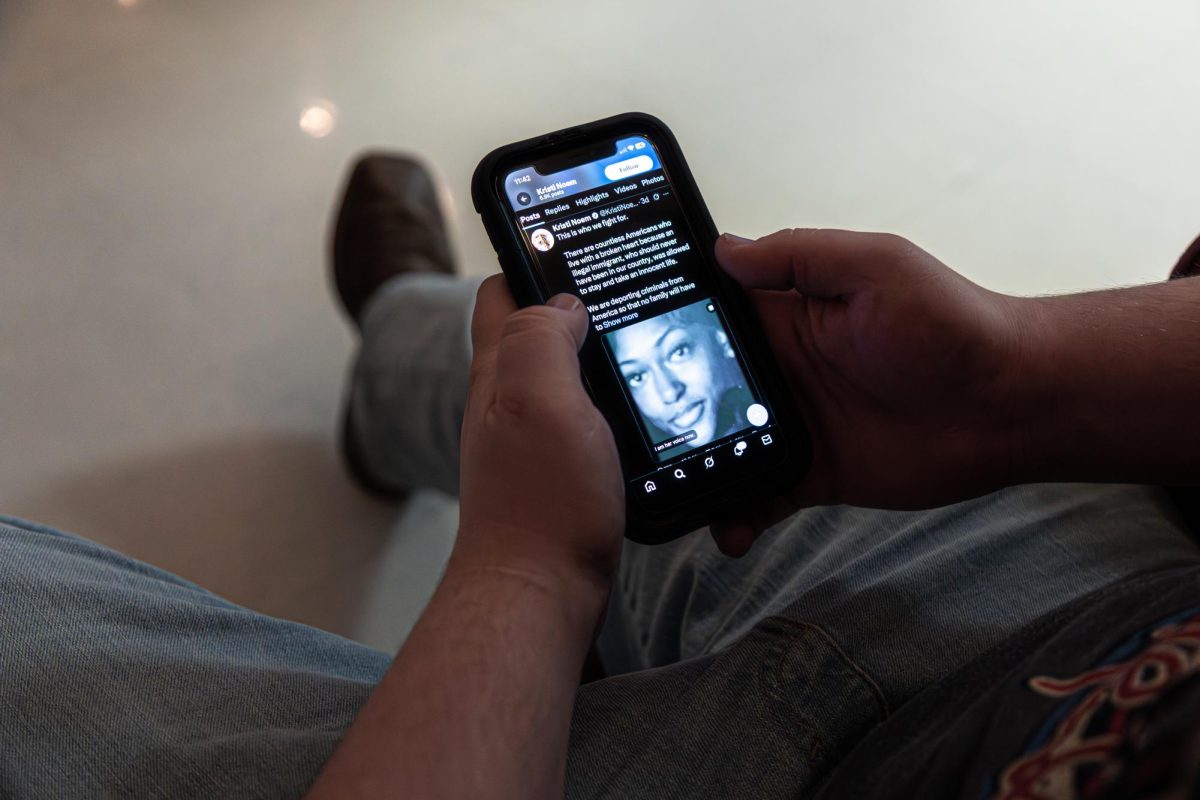
One of the most concerning developments of the United States government in recent years has been the misuse of social media. This has gotten especially bad under the Trump administration; specifically, on the accounts of political commentators, the Department of Homeland Security, and Donald Trump, social media has been used to control the narrative, spread division, and as a way for figures to bully their political rivals.
The largest benefit of political figures utilizing social media is that it allows them to broadcast their message more directly to their constituency, while also making it easier for constituents to see what is happening in government without necessarily needing media coverage. Junior George Stallings sees many productive political posts online.
“[I see] a lot of videography, just going through policy changes and how that process works, describing upcoming plans for during the presidency,” Stallings said. “From what I’ve seen, a lot of the time, social media is used as a form of socialization and [it] helps people expand their views. It is good to use it to actually show policy and how that’s being used for the good of our country, instead of just infotainment.”
However, recently, politicians have begun to misuse social media as a means of ‘airing out their dirty laundry,’ so to speak. Most famously has been Donald Trump’s usage of Twitter to criticize his party mates, such as the infamous November post regarding Marjorie Taylor Greene, where he referred to her as “Marjorie Taylor Brown,” adding “(Green grass turns Brown when it begins to ROT!)”. He then goes on to claim she is a traitor to the entire Republican party. This online beration continued when he took to Twitter (X) to address his grievances with more members of the Republican party, whom he labeled RINOs (republicans in name only). Eventually, this led to Greene’s resignation on Jan. 5.
It is highly immature for politicians on any side of the aisle to talk like this online. This is the government, not “Mean Girls.” Politicians should never utilize their platform for the purpose of insulting other politicians. They are placed in positions of power so they can handle legislation and management of the nation, not so we can view it like reality TV; it’s not TV, it’s just reality. There is no good reason why politicians should be employing social media posts the same way immature young people argue through Instagram notes. Unlike the squabbles of teens, when politicians utilize social media like this, there are consequences.
Similarly, government agencies, especially the Department of Homeland Security, have been utilizing social media poorly. On Jan. 6, the official DHS account posted an edit of Donald Trump and their operatives on missions to the tune of “Macarena.” Regardless of a person’s opinion on ICE’s and DHS’s actions, it can be agreed that those agencies should not be taking this assignment lightly. Just because the people they are (or are supposed to be) arresting are in the country illegally does not mean the government should be working this rapidly to the point of being imprecise with who they are deporting. It looks even worse when people log on to social media to see a Trump and DHS edit on the agency’s official account. Junior Chris Allen has found that there may be a deeper purpose beyond trolling behind some of these posts.
“From the current administration, a lot of the posts I see are directed towards Gen Z individuals, where the post would be a very trendy sound, a very trendy type of post,” Allen said. “They’re putting pictures and videos of immigrants being locked up under these sounds and chains and shackles and just horrible things under these very trendy audios to get Gen Z to watch it, and it is working. People are watching these videos.”
Beyond posing on social media to broadcast immature squabbles, posts have also been made to spread misinformation. Both sides of the aisle have narratives they want to push; this was exemplified by the fatal shooting of Renee Good by ICE agent Jonathan Ross. Now, I think it’s important to say that whenever an incident such as this occurs, it is important to research it to the furthest extent possible.
Personally, I watched all three public camera angles of the fatal incident and a video by YouTube user ‘Dr. G Explains,’ who claims to be a psychologist, titled “ICE Shooting of Renee Good the Missed Details: Body Language & Psychology” wherein he explains what he notices about the body language and how the timing and both the officers and the victims past experiences had likely affected their thinking. He claims they were both experiencing an overwhelming fight or flight response.
Good chose to escape the situation by car; meanwhile, Ross, who had prior experience being hit by a car while on duty, was still in front of the car. This resulted in Ross discharging his firearm into Good as a reaction, likely based on his previous experience being hit and dragged by a car, without enough time to process the fact that she was trying to turn.
However, politicians on either side of the political spectrum posted their choice between the two camera views from nearby security cameras, one making it look like Ross was hit more fully and then fired (a front view of the car), the other appearing as though the car had begun to move innocently and was then fired into (the recording with a rear view of the car). Very few, it seems, posted the handheld footage Ross had taken with his phone, which tells a completely separate story from the two others; together, they can be used to more fully understand the circumstances under which the shooting occurred.
Overall, it’s important that politicians refrain from acting with such a large lack of propriety online, and that they reconsider how their posts affect the views all citizens hold toward the government. We should be able to hear about actual policy without partisan drama filling in between anything actually productive in government.