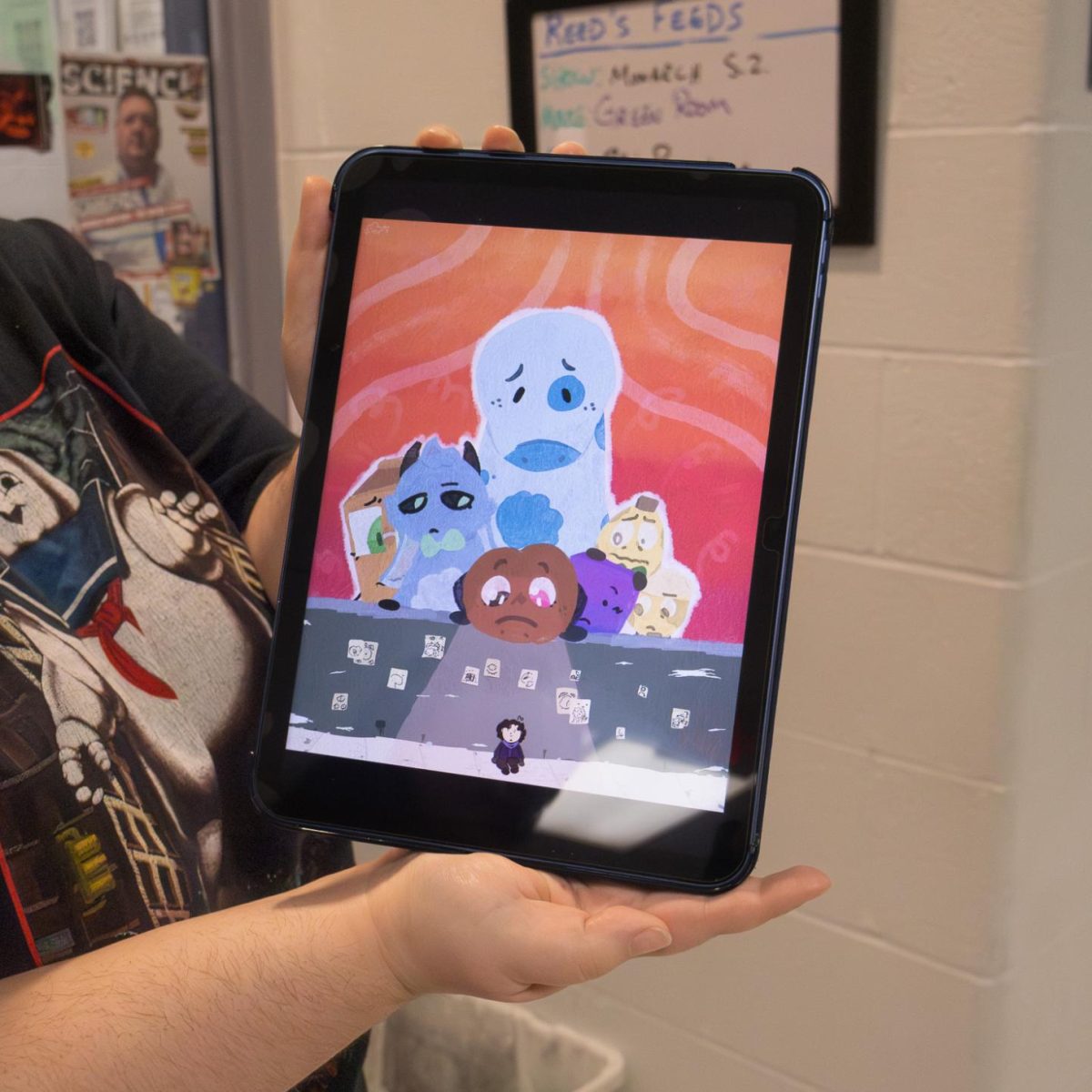
Sunlight spills across the desk as a senior Kate Hewing scribbles away in her sketchbook. Jam-packed with designs galore of ideas of the future characters she is making, she pulls pieces from multiple of her favorite works of media, bringing these designs to life, like a modern-day Frankenstein. Many artistic students at FHC go unnoticed, their imagination helping them curate the perfect personality for their homemade character, which exists only in their hands and minds until it is spread to the world. Students sometimes create their own original characters, also known as an OC, to tell stories, express themselves, explore their identity, or to connect with others. Hewing prefers drawing people over other muses because she has had a love for it since she was a little kid.
“[I draw] recreationally, and I also think I want to go to school for it. I want to be a graphic designer. I prefer to draw people, because there’s more depth to people than walls. No offense to the architects out there,” said Hewing. “As a kid, I loved making heroes. I’ve had superhero OCs since I was little. When I was seven, my friend and I made superhero OCs named Lightning and Thunder. We would play around on the playground and play with our OCs, and I really missed making heroes. That’s something I’d do my whole life, along with drawing. I should just make new ones. Who’s stopping me? I’m not too old for that. It’s a job somewhere, “
Art, especially of individuals, brings people together through the multiple muses they have and their shared experiences. Art gives voices to perspectives and stories that could have otherwise gone unheard. Hewing wants to be the representation that others can look up to in the future.
“I want people to look and be like, ‘Yes, that is something I could do. It’s possible.’ You could be in a space full of white people and still be valid. That’s why I created these characters. That’s why I like them so much. They’re very important to me. I hope that they can be [a] representation for groups that don’t get it,” said Hewing.
Many of the students who have their own original characters have been working on them for a long time, constructing and perfecting them. Making these characters is a tedious process that can take years to curate the perfect backstory and visual designs. Students’ original characters are an extension of themselves, or at the very least, they take details from themselves and add them to their personas. Senior Ollie Robins enjoys drawing people because it allows for creative freedom, and they can explore their artistic style.
“I have been drawing recreationally since I was at least seven. I’ve always enjoyed drawing people more than places. I love places, don’t get me wrong, but people, there’s a lot more variation, especially for characters in general. You gravitate towards them because they’re more familiar, and you can build on them more easily. It’s easier to think, ‘What does this person like?’ My OC is on every single thing I do. She has been over a lot of variations, and I always try to incorporate her in any art piece that I do,” said Robins.
Students use character creation as a form of creativity to help convey the stories they have and the emotions they feel. All OCs look different, considering they come from an accumulation of oneself; an OC isn’t always a complex character, it can be as simple as a doodle someone always draws on their paper to signify themself. Robins believes anyone can make an original character and that students can put as much effort or as little effort as they see fit.
“[Making an original character is] really not as hard as people make it out to be. The characters you see who have these complex stories and all of this lore and love and attention to them, there are people who have poured that love [into] them, but that doesn’t mean that you have to go in swinging with a thousand drawings, a thousand ideas. You can start off with a circle and add a weird horn there, an eye there, as long as you like it; that’s the basis for a character. I’ve known people who have made thousands upon thousands of characters just because they come up with a new idea every single day. Some people who have one [OC] stick to it. It’s your original character. You really [have to] focus on what you like about it.”
Focusing on subjects one is familiar with when creating original characters can build confidence and reduce anxiety. Everyone knows that “practice makes perfect,” but that particularly applies to creating art. With the repetition of making one’s characters, it is important to focus on consistency over perfection. Junior Max Sarver focuses on their own principles, and believes others should, too when writing an OC.
“When making an OC, I think about what the story needs and then how these characters can fit into place with my [Dungeons & Dragons] players. Make [your character] so that it’s something you can comfortably like. If you’re a really conservative person, maybe don’t play/make an outgoing character. Don’t go against your own beliefs and morals,” said Sarver.