

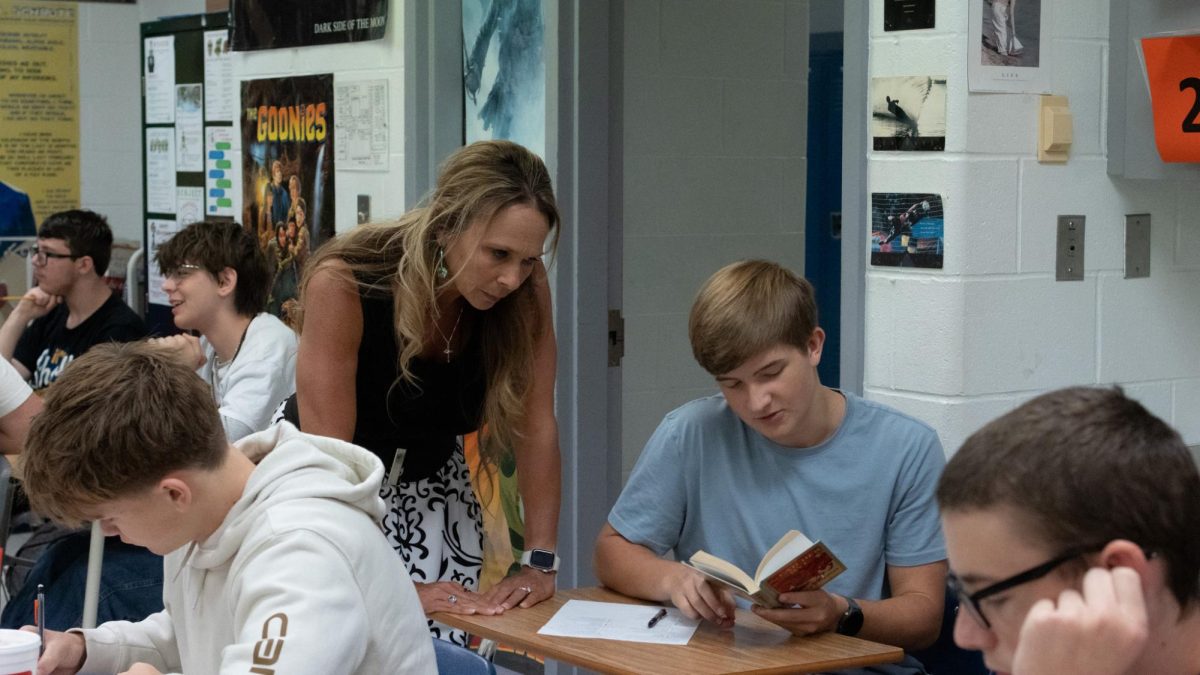
Amidst the melting pot of opinions on the new ban of cellphones and other personal devices in the classroom, art teacher Ashley Runge has noticed an overall improvement in student participation and interaction since the implementation. In years past, Runge noticed problems with student morale in her class. Many students would use their phones to conceal themselves from not only their peers but also their schoolwork and projects. After the enforcement, she has witnessed students who used to typically spend their entire class period on their phones now conversing with other students, asking them questions and trying to get to know each other even though they might not have had much in common in the past, and putting more effort and emotion into their work.
“Last year, I’d say there were a lot of kids who, if they weren’t really connected to art, they would use their phone to kind of hide, and now I think that has eliminated it. So now they’re kind of forced to interact with it, and even though some kids might hate that, it’s necessary because they need to try. Like, you know, they need to try different things,” said Runge.
After the initial controversy of the newfound ban, there have been mentions of having one-to-one with students and Chromebooks; however, is that really what students need? Is the answer to getting rid of our technology, adding more technology into the classroom, or is it just what our school needs to further students’ learning? Although having Chromebooks for each individual could help the school academically, it would be not only financially burdensome but could also become yet another distraction. This could cause the school to end up right where it started.
“I think that we need to learn how to scale back, not put more because the problem isn’t technology,” Runge said. “You all know how to use the technology, obviously, very well, even probably better than most of us teachers. But I would say that the problem is learning the etiquette of when to put it away, when to know when’s the appropriate time to have it out, when’s not…I think this rule is going to help everybody kind of learn about their phone etiquette.”
Students have also been completing assignments without distractions and collaborating with peers during class time. Without phones to rely on, students are putting a lot more effort and authenticity into their schoolwork. Whilst everyone is still trying to adjust to the ban, students are trying to figure out how to fill their downtime at school. There has been a major increase in students’ reading, conversing, doodling, and playing classroom games. U.S. government and physical science teacher Nick Jury has observed students filling their free time with more thought-provoking activities.
“I think it’s the thing I noticed, like, when kids used to have free time, they were just getting down on their phones, now they’re playing games, interacting with each other. Just finding other ways to occupy that time when they have some free time,” Said Jury, “I definitely noticed more students reading when they have that free time or that downtime. They’re breaking out a book and engaging in that book, and I think that’s great.”
There were many students who listened to music to get work done or used their devices to take notes in class. One of the biggest complaints about the ban is for students who want to be productive and stay in school while having a blended class and wanting to use their device for academic purposes. If you weren’t made aware that it was a flex day till that class hour and you forgot to sign up to flex to the library before school, you now can’t travel to the library. Senior Anshdeep Thind is a student of FHC who used her device to help her education excel.
“I bring my own laptop to school, and the reason why I do that is so I can log into my laptop faster and have things the way I want it to be. And not have to get up and get a Chromebook, log in, which takes a good 10 minutes of class and work time. And in comparison, I could just pull out my laptop and put the password in real quick and then go to Canvas I have linked up in my bookmarks, and quickly get to my work really fast.” Said Thind.
On the contrary, students have also been able to make the most of their school day. With distractions removed, students are spending more time actively engaging in class, whether that be discussions, notes, or just overall participation. Students are able to maximize their time in school so that after school can focus on what they want to do without as much worry of homework. Thind recognizes both the positives and negatives of the ban and that it’s a nuanced situation.
“I think one of the things I learned is that not having a phone really makes you want to get your work done on the spot rather than doing it later on in the day or saying, oh, I’ll do it later and then procrastinating and not getting it done…so you really get to lock in and focus in on what the teachers is really talking about and asking questions right there and then rather than asking later,” said Thind.
The ban has also caused concerns with safety, because a lot of students feel uneasy about not being able to as easily access their guardian or parents in an emergency. Many students also feel as though the ban is extreme, since students are not allowed to use electronics during passing periods and especially lunch. Senior Ella Rice noted how there are some aspects to the ban that seem almost unfair or unnecessary, whilst still being beneficial to students.

“I do think it would be nice for you to be able to use your phones at lunch for students, just to have a little bit of time. But I do think it’s also allowing [students] to communicate with each other more and talk face to face and keep them, so I think that’s a good thing,” said Rice.


