

Be honest with yourself. If you had a large mountain of homework waiting intimidatingly as its expiration date on the Canvas calendar approaches, would you distract yourself by clicking on a social media notification for a moment or two? Or, would you kick your phone away, focus first, and leave distractions for later?
Distractions and temptations are common for all. But, for students, school can be more stressful, and an ‘accidental’ touch of a finger to open an entertainment source can remove the stress momentarily, causing them to consider the temptations. What students don’t realize is that giving into temptations can turn into addiction, which leads to a reduction in study time and an increase in leisure time.
As per the National Health Interview Survey (taken from 2021 to 2023), “about half of U.S. teens report four hours or more of non‑academic screen time per day, excluding schoolwork.” The researchers also pointed out that, “as a huge portion of after‑school hours is spent on screens rather than studying or other activities, the amount of time available for study, sleep, and focused learning decreases.” Ultimately, the increase in leisure time decreases productivity, grades and health.
Missouri implemented a phone policy in response, which aimed at reducing distractions with the expectation that students would be able to focus better and improve their academic achievement.
“The benefits [of the phone policy] are definitely more prevalent [now]… More students are focused and improving their grades in the long run,” Mrs. McClendon, a debate teacher at FHC, said.
The policy has assisted building academic performance and improved physical socialization. Many students are actively participating in school and are more serious about their academic performance and grades.
“I think it’s beneficial, because it helped [me] focus more on work inside of school. [I] also feel that it has helped me socially [improve], as I have talked [to more] people and asked for help rather than [searching] Google,” senior Kiersten Morris said.
Students feel a drastic change in their skill set and focus level in addition to an increase in their grades.
“[You] won’t believe it, but when I started out [as a] freshman, [I was] getting really distracted. [The policy] really helped me improve my grades this year, as I was able to focus more.” Samuel Budde, a senior, said. “ I get more reading in, [which] I was never able to do, [and I] find things that I enjoy, such as talking to [friends] and drawing.”
It’s true that removing distractions not only raises integrity while learning, but it also boosts hidden skills, as Budde experienced. Even without the policy, distractions can still be controlled.
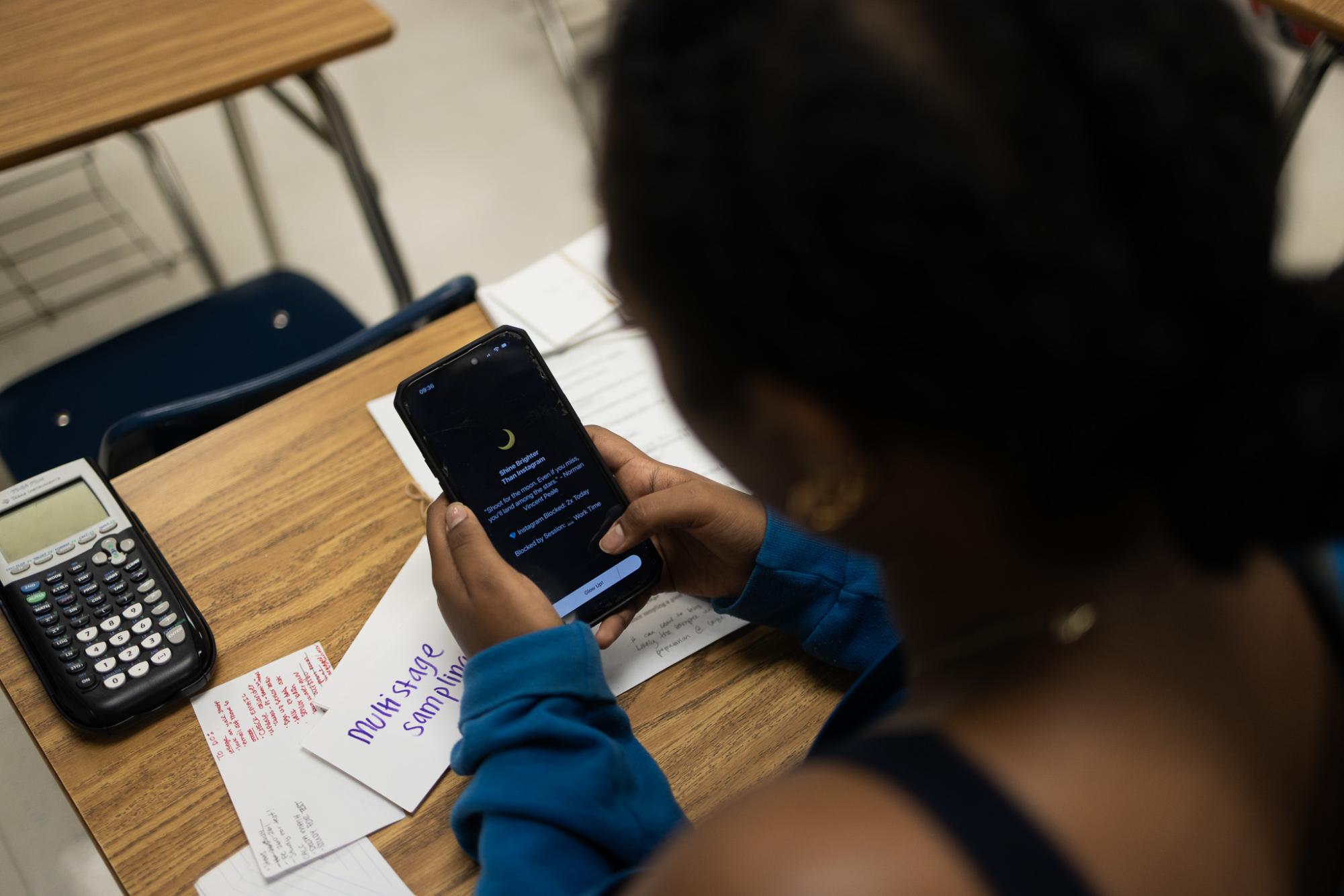
“A big thing for me [was] to turn off all the notifications so [that] I’m not checking it quite as much. Sometimes, I’ll actually delete the entire app [from] my phone so that I’m not tempted from the beginning,” McClendon said.
Some students use calming music, while others use different techniques to improve their focus during study time.
“I listen to Spotify music [whenever] I try to do my work, as [it] keeps me focused… Another [thing] that works for me is setting up timers. [For] this amount of time, [I’ll] do homework, and then give myself a break to do whatever [I] want, and then do homework again,” Kiersten said.
With the freedom given, it’s hard to manage academic performance and mental health. Regularity in one’s schedule helps significantly, in addition to adding screen limits or timers.
As per 21k School, “Students must build up study discipline. This means setting up the place, making a study plan, and using ways to control their body and mind.”
Ultimately, it is a student’s decision to choose whether to be distracted or remove distractions during their study time.
“[As] our technology [is] advancing like our tools have in the past, many sources of [distractions] will increase. It’s always going to have some downsides to it. [The] choice is ours. [Whether] we choose to depend on distractions that would harm our grades and academic performance, or [we] choose to help ourselves and [improve] our performance,” said junior Konner Martian.


