

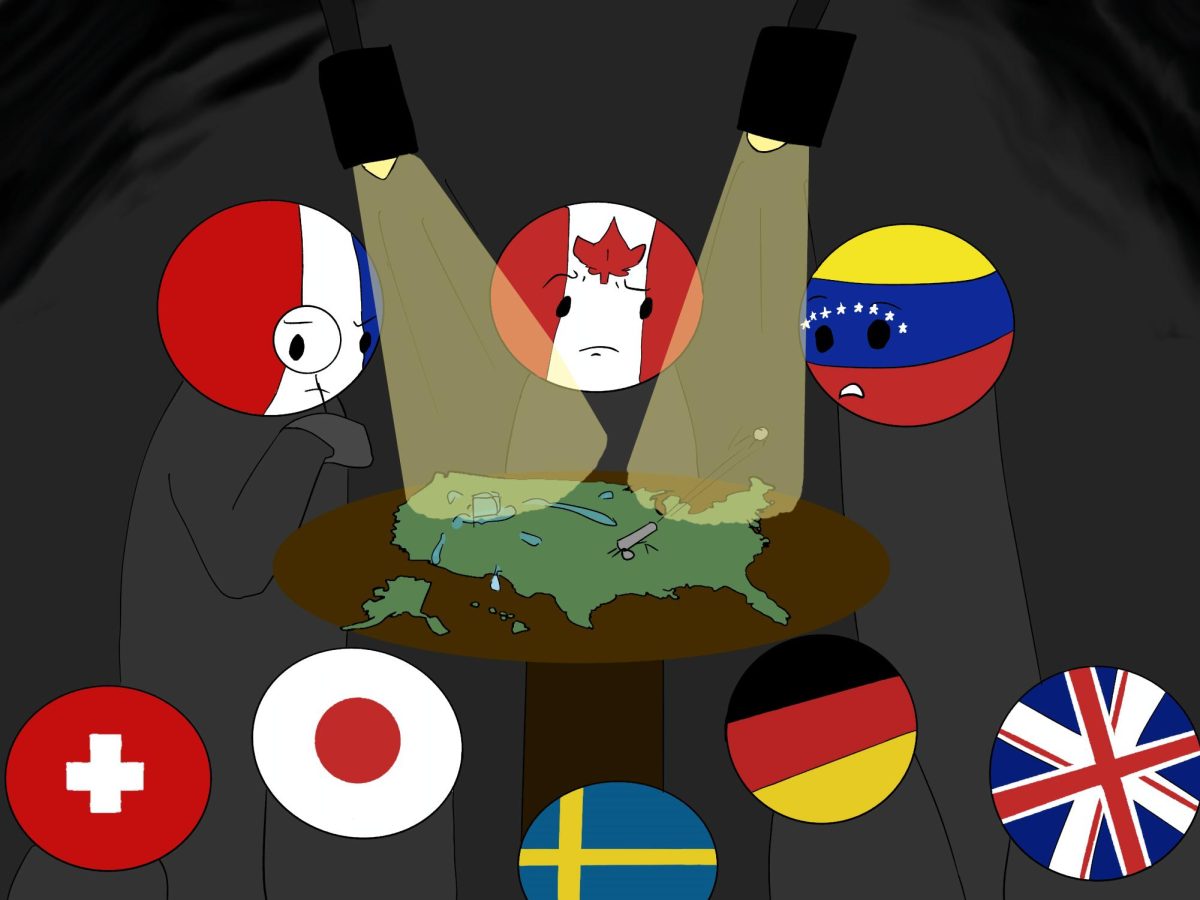
Congratulations! You can now awaken, check your phone, and be confronted with a text message, a weather alert, and 15 things the United States has done wrong in the 30 minutes you’ve been scrolling. Global commentary, once a distant echo, now arrives embedded in social media feeds, notifications, and addictive algorithms that could rival Sisyphus’s boulder. The distance across the pond has become solely physical, with the media connecting us all.
Through illustrating this broader principle, it brings awareness to the verity that U.S. actions abroad invariably generate repercussions that return home, and vice versa.
For students like junior Hayden Roumpos, knowing and understanding the global reverberations of domestic policy is increasingly essential.
“Eventually, even if it doesn’t right now, it’s going to affect everybody,” he said. “You think that’s probably not gonna get to me, or it’s happening to a different group of people that you’re not in. But if you allow it to happen to somebody, it can happen to everybody.”
The awareness that global events impinge upon daily life transforms otherwise negligible headlines into tangible realities that affect daily life — from trade and the industries to protests abroad — and can cascade into domestic consequences. Roumpos explains the direct correlation between the macro scale of events and the implicit impacts on an individual level, explaining the importance of global awareness.
“Global events will also eventually get back to us … there could be long-term effects if something’s happening in another country that could cut off their ties to us or affect some industry that we need here,” he said.
AP Government and Contemporary Issues teacher Nick Beckmann describes the United States as a pivotal node within a complex international system, where domestic actions precipitate global reactions that ultimately return to influence the national context.
“A lot of what we do here has ramifications globally, and what happens globally has ramifications here,” he said.
The repercussions are often asynchronous and unevenly distributed, yet still persistent and consequential.
Laurie Fay, AP Language and Composition teacher who has recently implemented quizzes over global news videos, echoes the necessity of attentiveness to developments on the global stage.
“Our country is very involved in worldly events, not just things that affect us here at home, and those things that can affect us more on a wide scale,” she said. “It may not directly impact me, but it will impact me in some way, whether it’s financially or in a humanitarian way.”
Recognition of these linkages enables more informed analysis of both policy and its downstream effects. The United States’ global footprint manifests in crises and quotidian operations alike. Decisions regarding trade, environmental regulation, and foreign diplomacy shape experiences and even worldwide impacts. Between the increasing mediation through international reactions of market volatility, political discourse, and social awareness, it produces a continuous feedback loop in which Americans encounter the consequences of their country’s decision almost instantaneously.
The modern citizen confronts a world in which global events are no longer peripheral but constitutive of domestic experience. Awareness, critical analysis, and contextual understanding are indispensable not merely for informed citizenship but for navigating the terrain of national actions and international consequences.
“Most media is biased in the way that they present their information…I like to look at various agencies and the information they put out so I can gain a more insightful and educated view of these,” Fay said.
Recognition of international dynamics through media literacy and engagement encourages a more sophisticated entanglement with policy, economics, and civic responsibility. So, the next time you’re caught in the unending whirlpool of Tiktok or Instagram Reels, try to stop swiping for brainrot and start searching for facts.


