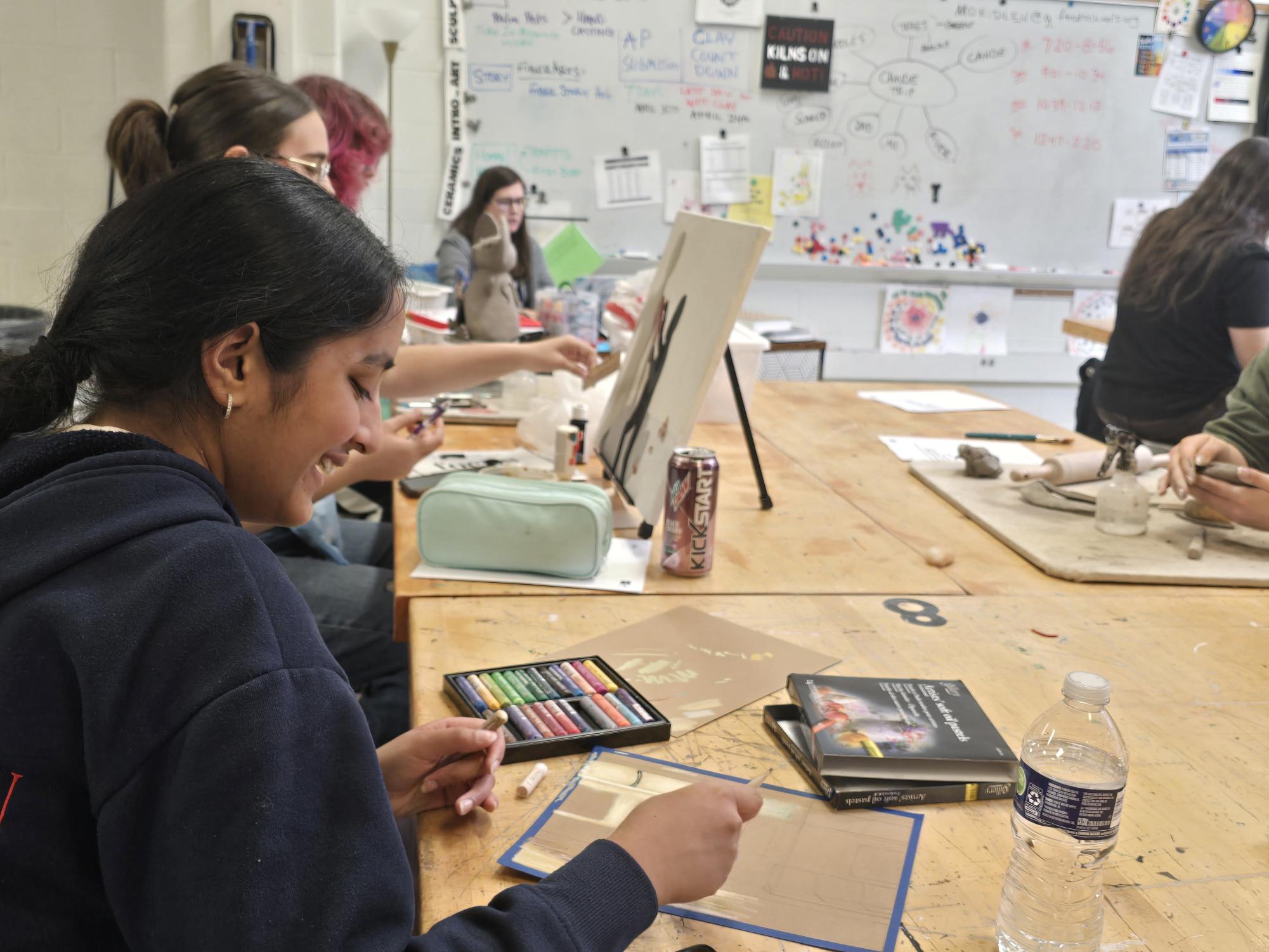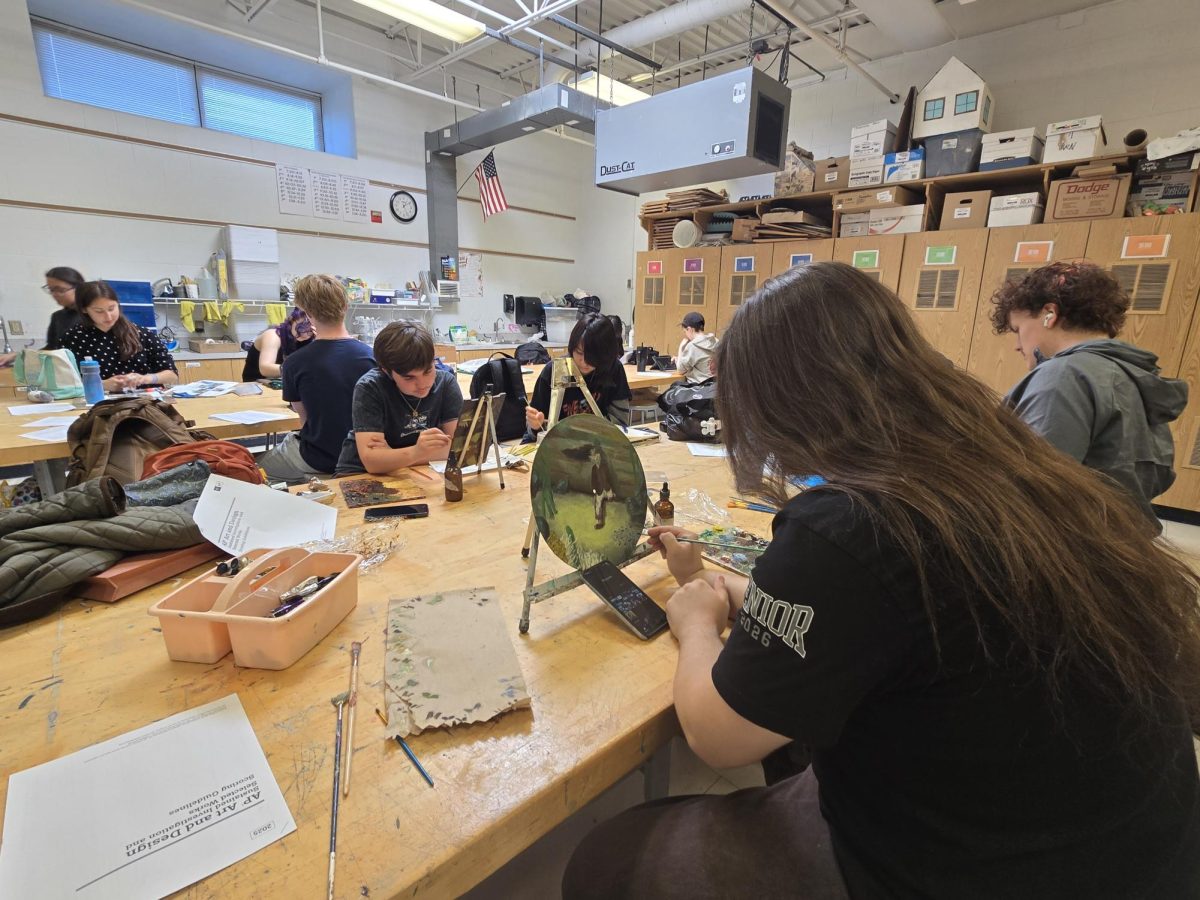
Paint-stained hands with smudged charcoal staining the fingertips beneath, paused curiously mid-stroke. Dayton Pagano, a student in AP Art & Design, dipped his brush once more into the graveyard of colors–the palette–and, with a bold move, added bloody red strokes to a figure with a chopped neck.
Pagano and his fellow students have spent sleepless nights finishing their projects. Their yearlong journey has been filled with many bumps, struggles, and revisions— where even making the smallest mistake can feel like a crime.
For students taking AP Art & Design, life isn’t simply loaded with paint or design, but with the art of growth, creativity and uncovering the hidden mysteries of questions that crowd their minds.
Unlike traditional AP exams, however, this journey simply does not end with FRQs, essays or multiple choice questions. Instead, students are tested by submitting a portfolio showcasing most of their year-long projects. Each project is unified by a ‘sustained investigation’ question that acts like a theme, which develops and evolves with every brush stroke.
“Sustained investigation is a question that they’re investigating. It can’t just be like, ‘I want to make an artwork about animals,’ but more about how I can show the connection to my family’s culture through exploring landscapes or religious animals that connect them [together],” Michelle Ridlen, the teacher of AP Art & Design, said.
Many students choose to explore personal themes such as identity, family, culture, or their own differences. Through this process, they not only gain a better understanding of themselves but also learn how to express those emotions and experiences by making creative artworks.
Some students walk the journey of characters from mythologies and uncover hidden secrets from the stories through their imagination, while others, like Pagano, go as far as to return to traditions of culture or music that eventually faded over time.
“I wanted [to] investigate music, since it [has] always been an [important] part of my life, and so I thought about trying to encompass it into physical art,” Pagano said. ” I have [selected] an album called ‘The Mollusk’ by Ween. It’s a bit creepy, [but] very interesting. This emotion is what I want to show through my artworks.”
Pagano expresses this through dark imagery, bloody red strokes, and unsettling underwater figures, using his artwork to capture the spooky and haunting mood of the Mollusk. To display this, he could have chosen different pathways by selecting different portfolio submissions. However, in his opinion, 2D was the best option available.
“There are three types of portfolio, namely AP drawing, AP 2D Art and Design and AP 3D Art and Design. AP Drawing and 2D design are [focused] on flat surfaces, leaving the 3D design to interact with space,” Ridlen said. “AP Drawing deals with sketching through pen or pencil, and using patterns, while in 2D, there is a digital option available, as well as painting. As for 3D, sculpture artworks are [required].”
Each portfolio comes with the same requirements, though. There should always be an inquiry question that leads to sustained investigation, which should show revisions and evolution.
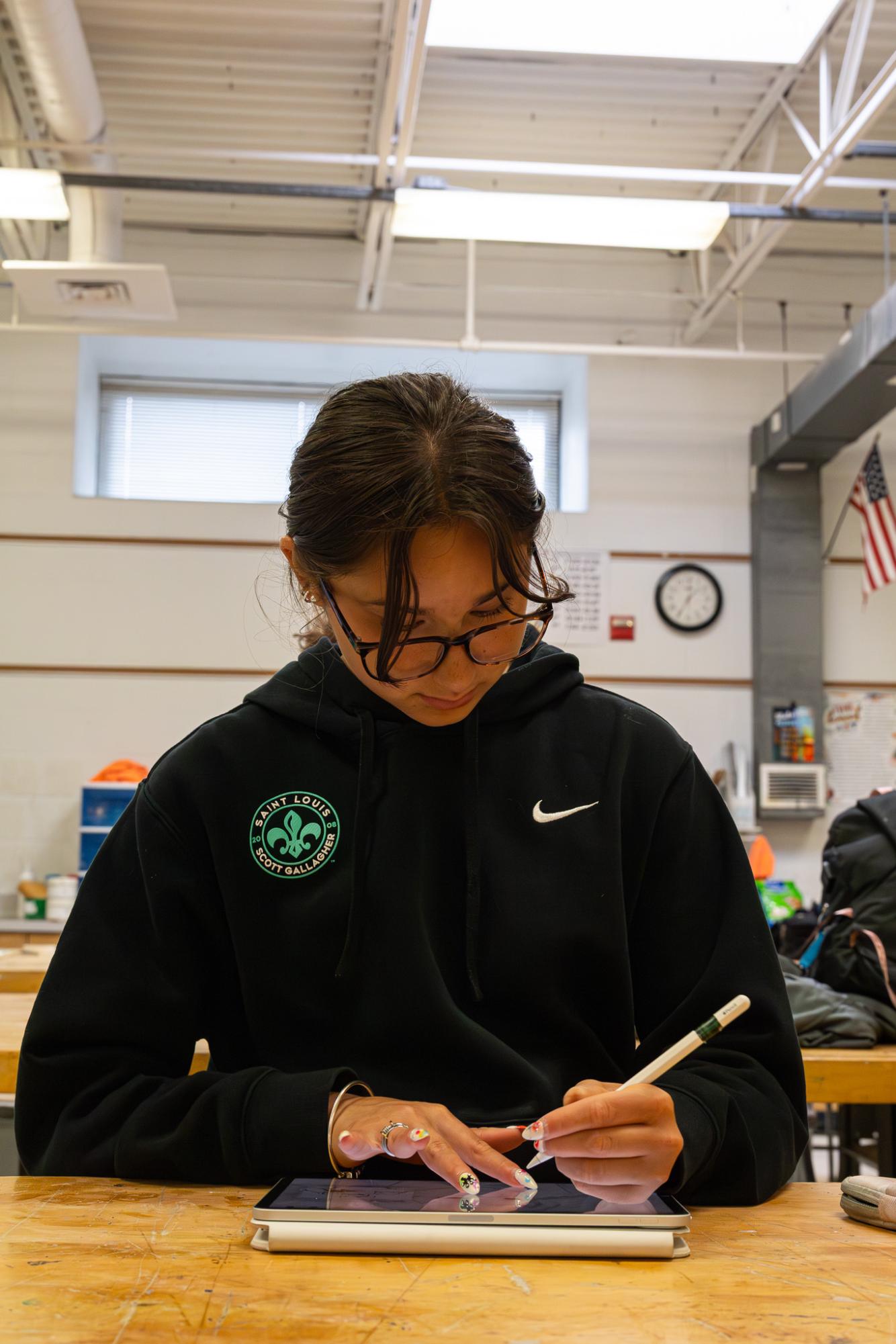
“I would say about eight to ten artworks surrounding your theme would work the best. [Since,] I have a theme [leaning toward] Korean mythology, my [artworks] usually display narrative or a story [digitally],” senior Madison McGowan said. “Besides this, [your artwork] should display growth and how your theme evolves throughout.”
The most crucial step in building a portfolio, as McGowan mentioned, is showing the evolution of the theme throughout the year.
“I learned a lot from my first few pieces that were not the highest quality. [Those] artworks helped me improve at least a little bit [over time],” Pagano said.
This process of growth is important because, besides the selected finished artworks, students are required to show evidence of practice, experimentation and revisions in their portfolio with documentation. Submitting an AP art portfolio isn’t easy.
“For [submission], they have to do two different parts. The first part has the sustained investigation and is in [the form] of 15 slides. And, [in those] slides, they have to show their process of experimentation, research, practice, and revisions [in] addition to writing a written investigation and [selecting] artworks,” Ridlen said. “The second part is more towards showing your five best artworks throughout this course.”
Alongside the stress of submitting the portfolio before the deadline, students tend to double-check for repetitive ideas and reflect the same investigative question in a different way through their artworks. As for Pagano, it’s easy to brainstorm this through making a variety of artworks based on his theme.
“You really have to think outside the box; that’s the whole point of taking this class. [Mainly it’s] challenging yourself, and not [showing] repetitiveness in your artworks,” McGowan said.
Besides the challenge, many students get the opportunity to socialize with like-minded people and learn new things throughout the year.
“It’s a really fun class, and you meet a lot of cool and awesome people. [Besides,] you don’t [have] to submit an art portfolio [for this]. Just having a class to break down and do some art can bring much [satisfaction] within itself,” Pagano said.